
Three new examples: customer reviews, banking queries and scientific research
Three new examples have landed. Will Poynter, Word Cloud Plus's creator, shares our examples using customer reviews, banking queries and scientific research.

Will Poynter
3 mins read
We have added three new examples to Word Cloud Plus, showing how word clouds can help us explore customer reviews, support queries and scientific research.
Until now, our examples page has featured three classic books. These are a useful way to demonstrate the tool, but many people have rather different text to work with. You might have a collection of product reviews, questions sent to your support team, or a folder of research papers you need to express graphically.
The new examples give you a starting point for each of those situations. You can find all six on the examples page, with links to the data sources and notes explaining how we prepared the text.
The first example uses 2,000 customer reviews from the Women's E-Commerce Clothing Reviews dataset on Kaggle.
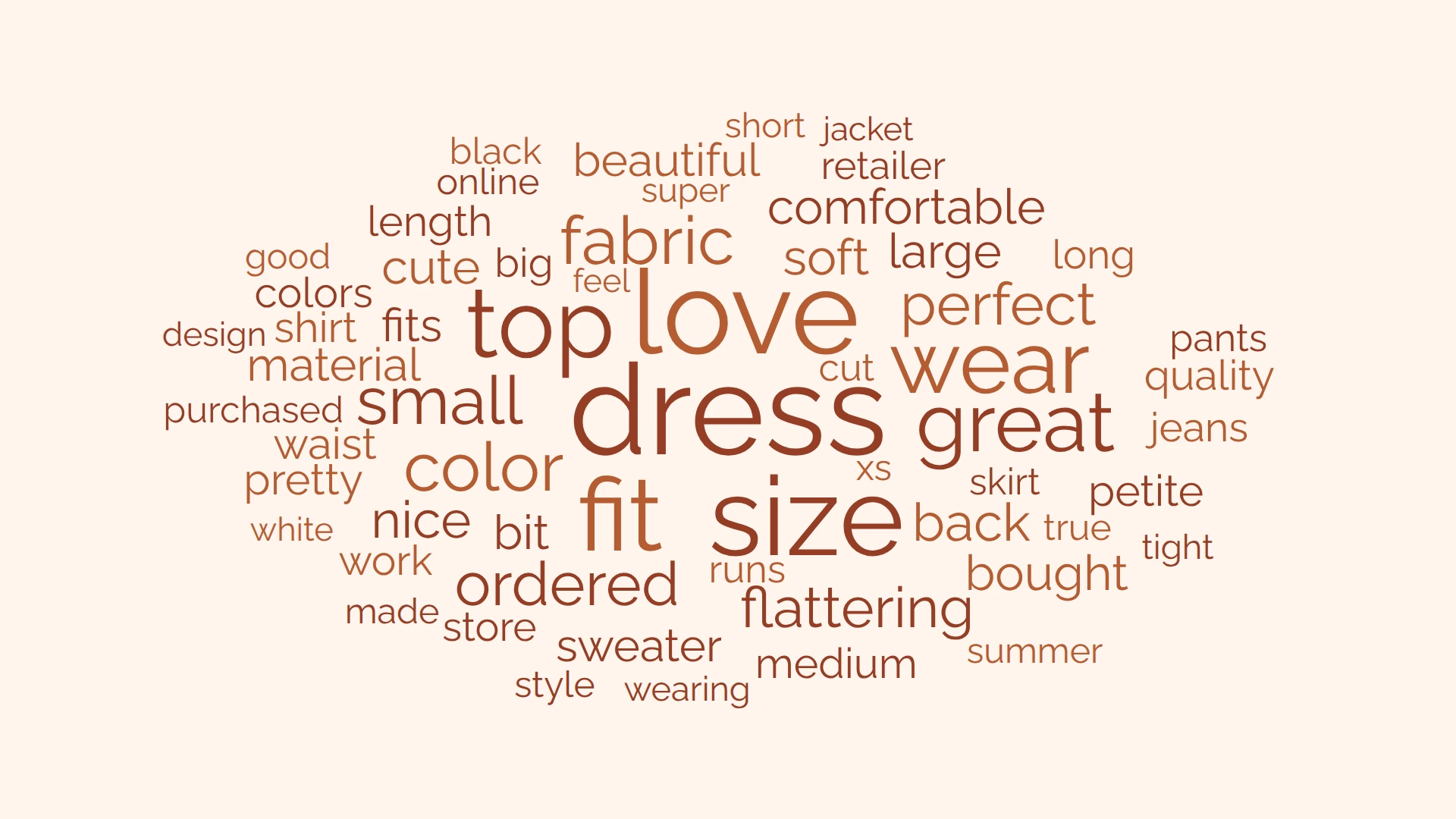
A sample of 2,000 unique review bodies. Source: nicapotato on Kaggle, CC0.
"Dress" is the largest word, which tells us something about the products being discussed. For me, "size", "fit", "fabric" and "comfortable" are more useful places to begin an analysis. They suggest aspects of the shopping experience that customers are taking the time to describe.
If I were looking at these reviews for a retailer, I would start by reading the comments about fit. Are people finding the sizing consistent? Does an item fit differently from what they expected? Are there particular products where the description could be clearer?
"Love" is prominent too, but we should be careful about treating that as a satisfaction score. Someone can love the colour of a dress and still return it because it does not fit. The cloud helps us choose what to examine; the original comments tell us what people meant.
The second example looks at customer support. We used 13,071 unique queries from PolyAI's BANKING77 dataset, which brings together questions about everyday banking tasks.
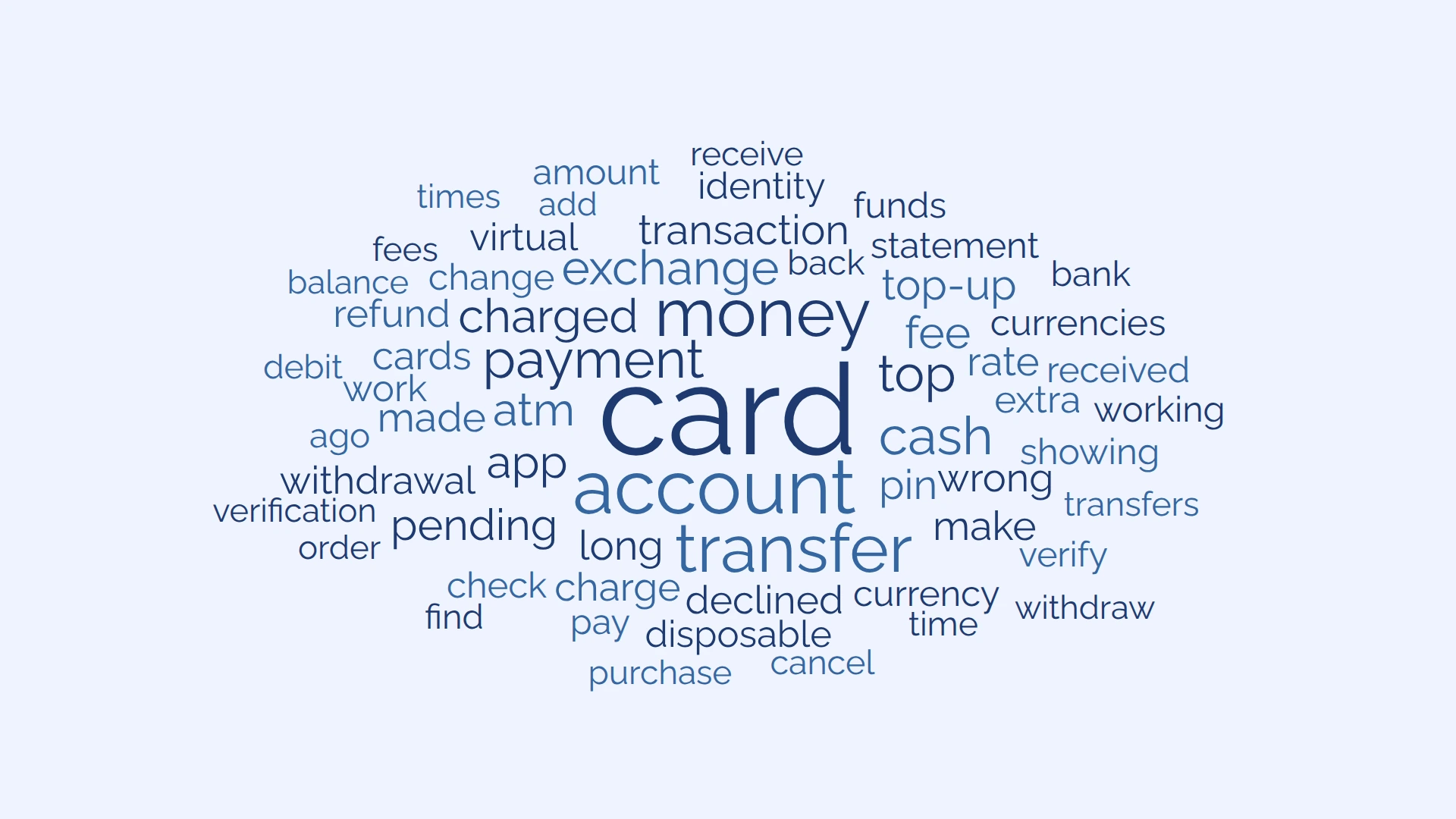
Unique queries from BANKING77. Source: Casanueva et al. (2020), CC BY 4.0.
"Card", "account", "money" and "transfer" stand out immediately. Looking a little further, we find words such as "pending", "charged", "declined" and "refund". These give us some useful directions to explore within those broad topics.
For a support team working with its own messages, this could be a way to identify questions for a help page or areas where customers need a clearer explanation. I would want to look at the queries behind "pending", for example, to understand which transactions people are asking about and what information they are missing.
There is an important distinction with this particular dataset. BANKING77 was assembled as a benchmark for identifying different types of enquiry. The size of "card" in this cloud does not tell us what proportion of a bank's customers have card problems. It demonstrates the kind of language we can explore, rather than giving us a ready-made list of business priorities.
Our third example moves into science. It combines 146 selected PLOS ONE abstracts from 2020 to 2025, found through a Europe PMC search for microplastics.
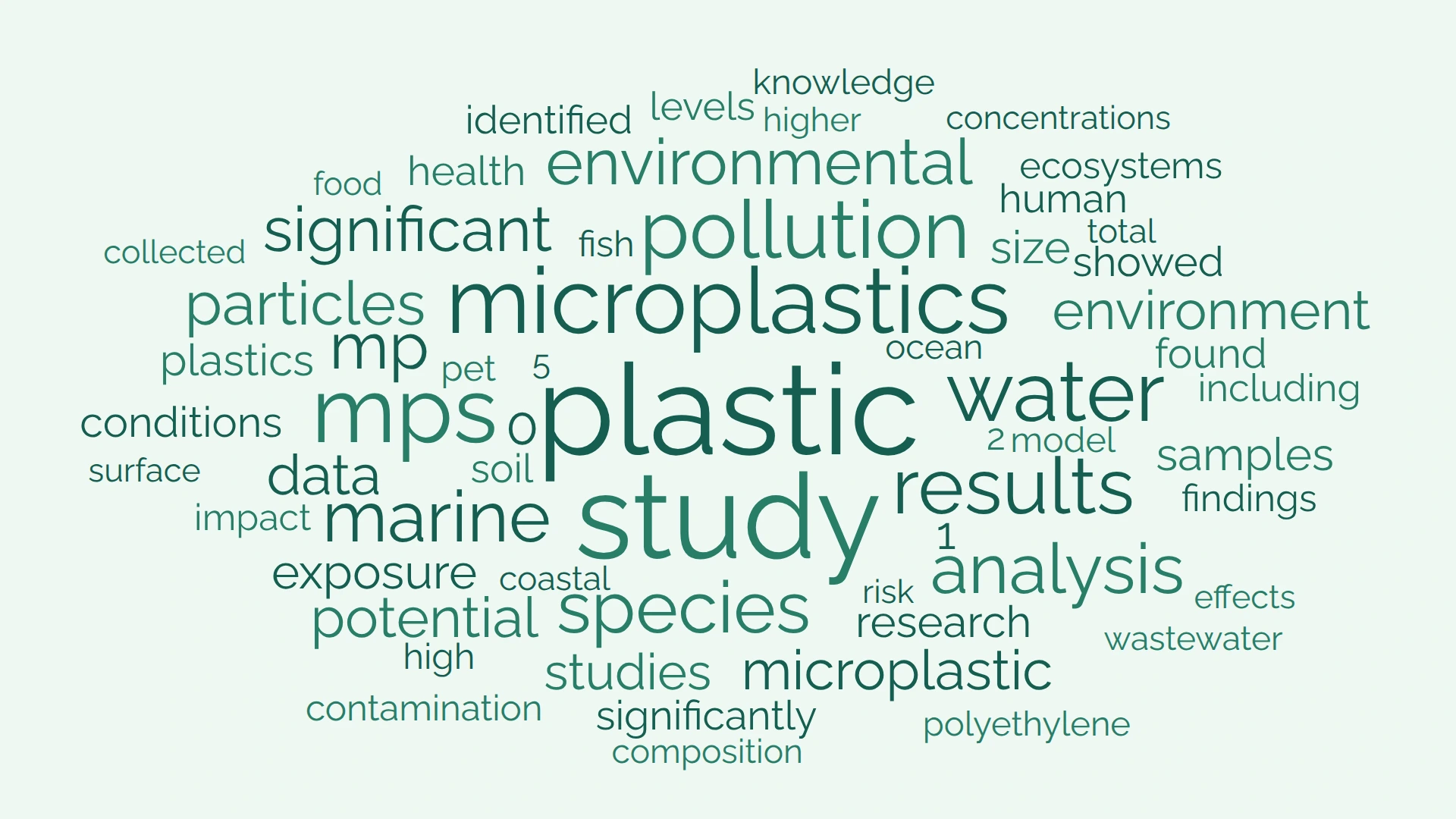
Selected CC BY abstracts. Article authors, sources and preparation notes.
Some of the largest terms are predictable: "plastic" and "microplastics" are hardly a surprise. Words such as "water", "marine", "species" and "pollution" give us a better sense of the subjects covered by this collection.
If I were beginning to explore this literature, I could use those terms to decide which papers to read more closely. I might also separate papers about marine environments from those about soil and compare the vocabulary in each group.
You will also notice "study", "results" and "analysis". These are common parts of research writing, so their prominence does not necessarily tell us much about microplastics. Depending on the question, removing them as stop words could make the next cloud more useful. A frequent word is a reason to look further, not evidence that a scientific claim is correct.
For these three examples, we have kept the method simple: each cloud shows 60 individual words, sized by occurrence count, using the standard English stop-word list. Blank and duplicate texts were removed when preparing the samples. The colours help distinguish the examples; they do not represent sentiment or categories.
I hope the additions make it easier to see how Word Cloud Plus could help with your own text. Take a look at the examples, or create a cloud from your own material. If there is another type of data you would like us to demonstrate, please let us know.
Keep reading
New Scoring Algorithms
We've been busy at Word Cloud Plus and delivered two updates to our scoring algorithms. Our default algorithm, Combination Counting has been upgraded to improve grouping of long phrases and score reallocation. What does that mean? Using one of our old favourite datasets of 1000 reviews of Disneyland Hong Kong. Combination Counting (new generation) Combination Counting (classic) Getting more from the Data Our new scoring algorithm already does a better job of pulling out longer phrases lik
A tourist tax with barely a tourist in it
The government's response to the overnight visitor levy consultation runs to 10,000 words. “Strategic authorities” appears 60 times. “Tourists” appears none.
The Eagle has landed — once
Two slices of the Apollo 11 air-to-ground transcript, one word cloud each. The most famous sentence in the whole corpus appears exactly one time — which tells you something useful about word clouds.
Try it on your own text
Paste text, rank the phrases that matter, export the cloud.