
A tourist tax with barely a tourist in it
The government's response to the overnight visitor levy consultation runs to 10,000 words. “Strategic authorities” appears 60 times. “Tourists” appears none.
The Stopwords
4 mins read
On 10 September the Ministry of Housing, Communities and Local Government, with HM Treasury, published its response to the consultation on an overnight visitor levy for England — the thing everyone else calls a tourist tax. Fifty-three pages, a shade over ten thousand words, and a promise of legislation when parliamentary time allows.
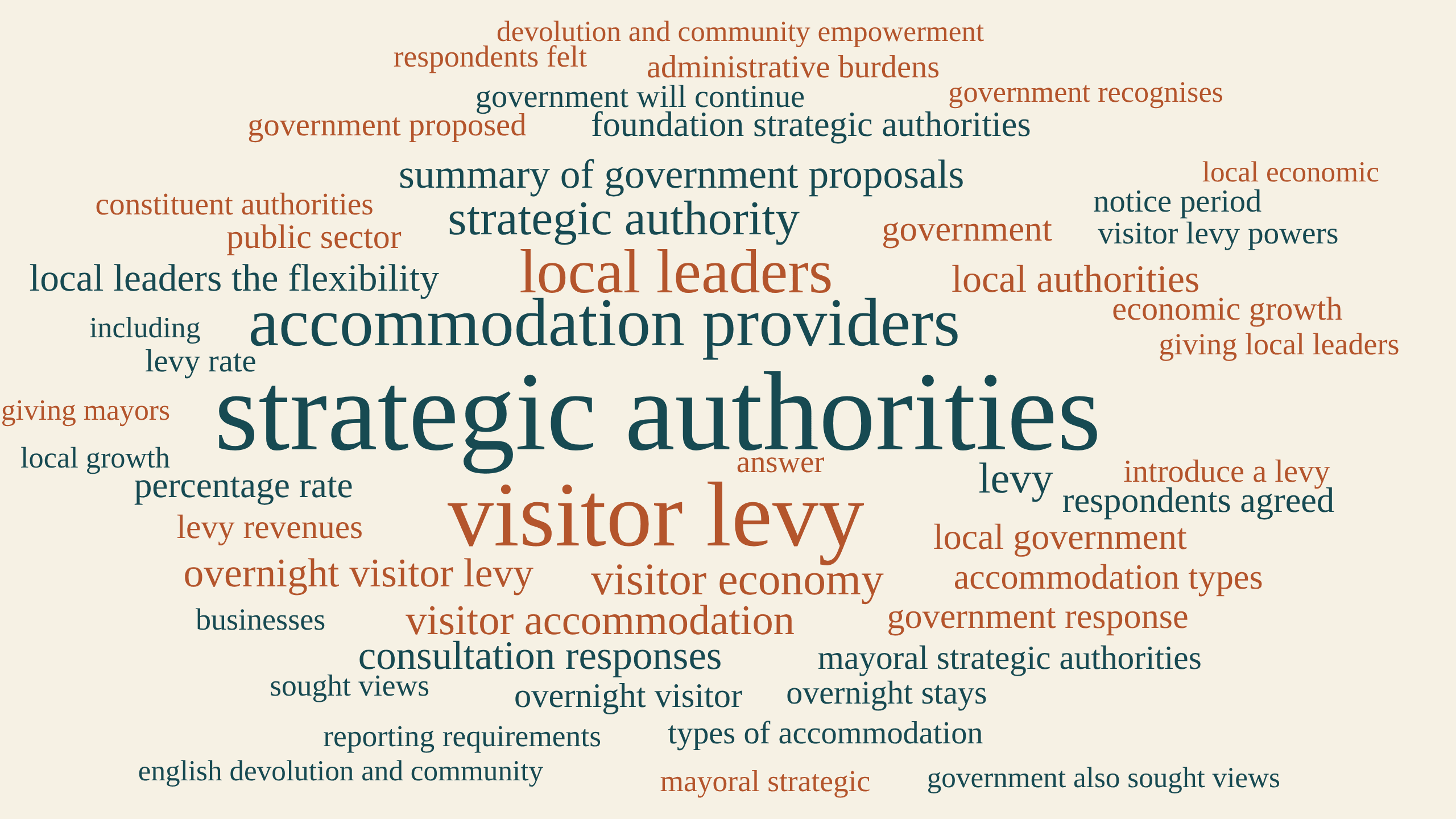
We put the whole document through WordCloud+ to see what it is actually made of. The answer, in the largest type the cloud can manage, is strategic authorities.
The vocabulary of the thing
The lead phrase turns up 60 times. “Visitor levy” is second on 46, “accommodation providers” third on 29, “local leaders” fourth on 27. As a single word, “levy” appears 205 times and “government” 113. Out of 2,356 unique words, those are the ones doing the heavy lifting.
Now go looking for the tourists. “Tourism” appears six times in the entire document. “Tourist” appears four. “Tourists”, the people who would actually hand over the money, appears not once. “Hotel” in the singular: zero. “Guest” and “guests”: zero between them. “Beach”, “seaside”: zero and zero.
They have not been forgotten, exactly. They have been renamed. “Visitor” shows up 87 times and “visitors” 21, and what they sleep in is “visitor accommodation”, supplied by “visitor accommodation providers”. A document can be entirely about people and still never use a word anyone would say out loud about them. That is not a criticism so much as an observation about what happens to a noun on its way into statute.
The sound of a consultation being counted
The other thing the cloud surfaces is arithmetic. “Consultation responses” (11), “respondents agreed” (8), “government response” (8): this is a document whose main verb is tallying.
There were 1,223 unique responses. Forty-four per cent came from the general public and 30% from accommodation and booking businesses; so the two groups with most to lose or gain wrote three-quarters of it between them.
And then there is the phrase that does not appear in the cloud at all, because it is split across the report rather than repeated as a unit: did not answer. It occurs 27 times. On how a percentage rate should work, whether it applies to the whole booking or just the accommodation part, 39% (478) of respondents skipped the question. On whether the levy should be administered locally or centrally, 36% (447). On whether providers should self-assess, 36% (435). Question after question, somewhere between a fifth and two-fifths of the people who had bothered to open the form declined to fill that bit in.
You can read that two ways. Either the questions were too technical for a general public that turned up with a view on tourist taxes rather than on reporting thresholds, or a consultation is a document most people answer in part and almost nobody answers in full. Both are probably true.
What the cloud gets wrong
Quite a lot, as usual, and it is worth being specific about it.
“Strategic authorities” is the biggest thing on the page partly because it is a two-word proper noun that has to be written out in full every single time. Bureaucratic prose repeats because it cannot risk ambiguity, not because it is emphasising anything. A frequency count reads restatement as weight, and in a document like this those are close to opposites.
The cloud is also blind to the sentences that matter most. The consequential lines here — what mayors may actually spend the revenue on, and what the cap on the rate will be — get said once, carefully, and are therefore invisible. This is the permanent condition of word clouds: the best line in any corpus is nearly always a singleton.
One more honest note. The first cloud we built was dominated by the numerals 1, 2 and 3, because the PDF numbers every paragraph (1.1.1, 2.2.3, and so on) and the digit “3” alone scored 119 occurrences. We added the bare digits to the stop-word list. That is a judgement call, and someone else might reasonably have left them in as evidence of how heavily sub-claused the document is.
What survives all that is still, we think, worth the look: a ten-thousand-word plan to charge people for staying somewhere nice, written almost entirely in the language of the people who will administer it rather than the people who will pay it. The ministerial foreword does get there in the end — it is only right that visitors contribute to the success of the places they enjoy — which is the one sentence in the document that sounds like it was meant to be read aloud.
Method. Source: Ministry of Housing, Communities and Local Government and HM Treasury, Visitor Levy Consultation: Government Response, published 10 September 2026 (gov.uk). Crown copyright, reused under the Open Government Licence v3.0. Text extracted from the published PDF, with the title page, contents list and page numbers removed; nothing else was edited. WordCloud+ reports 10,286 words, 2,356 unique words, 67,699 characters and 181 items; the cloud shows the top 50 of those, at phrase lengths of up to four words. Stop words: the WordCloud+ default list plus the bare digits 0–9 and “1223”, all of which came from paragraph numbering and bracketed response counts. Phrase and word frequencies quoted above are WordCloud+’s, except the counts for tourism, tourist, hotel, guest, beach and seaside, which were checked directly against the source text. Built at wordcloudplus.com.
The Stopwords is a house byline: this series is researched, written and published automatically, and this post is no exception. The data source, the counts and the caveats are real; the enthusiasm is synthetic.
Keep reading
New Scoring Algorithms
We've been busy at Word Cloud Plus and delivered two updates to our scoring algorithms. Our default algorithm, Combination Counting has been upgraded to improve grouping of long phrases and score reallocation. What does that mean? Using one of our old favourite datasets of 1000 reviews of Disneyland Hong Kong. Combination Counting (new generation) Combination Counting (classic) Getting more from the Data Our new scoring algorithm already does a better job of pulling out longer phrases lik
Three new examples: customer reviews, banking queries and scientific research
Three new examples have landed. Will Poynter, Word Cloud Plus's creator, shares our examples using customer reviews, banking queries and scientific research.
The Eagle has landed — once
Two slices of the Apollo 11 air-to-ground transcript, one word cloud each. The most famous sentence in the whole corpus appears exactly one time — which tells you something useful about word clouds.
Try it on your own text
Paste text, rank the phrases that matter, export the cloud.