The Eagle has landed — once
Two slices of the Apollo 11 air-to-ground transcript, one word cloud each. The most famous sentence in the whole corpus appears exactly one time — which tells you something useful about word clouds.
The Stopwords
4 mins read
At 102 hours, 45 minutes and 40 seconds into the flight, Buzz Aldrin said two words: “Contact light.” Seventeen seconds later Houston said “We copy you down, Eagle.” Two seconds after that, Neil Armstrong: “Houston, Tranquility Base here.” Five seconds after that, the line everybody knows.
“The Eagle has landed” appears exactly once in the Apollo 11 air-to-ground transcript. So does “one small step.” So does Aldrin’s “Magnificent desolation,” logged at 109:43:24 while he stood on another world. The full transcript runs to roughly 123,000 words across 8,433 logged transmissions. Three of the most quoted sentences of the twentieth century account for fewer than twenty of them, and not one of those sentences shows up anywhere in either of the clouds below.
That is not a flaw in the method. It is the whole point, and we will come back to it.
Getting there
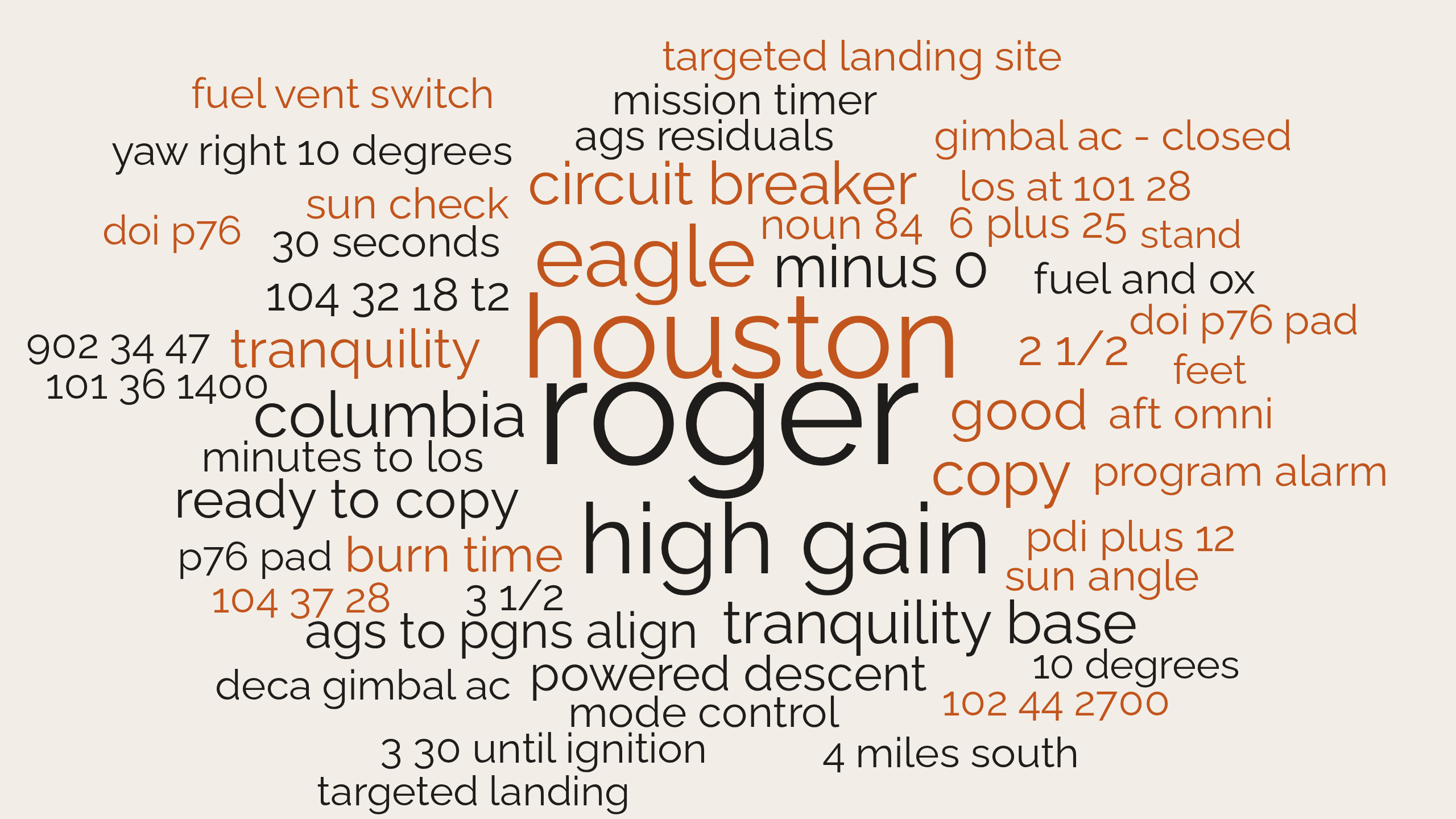
The cloud at the top of this page is the two and a half hours around the landing: ground elapsed time 101:00 to 103:30, covering final approach, powered descent, touchdown, and the first few minutes on the surface. That is 401 transmissions, 3,850 words, 1,108 of them unique.
The biggest word is roger, 118 times. In a corpus this size that means roughly one word in every thirty-three is somebody confirming they heard the last thing. Houston is second at 83. After that it is almost entirely furniture: high gain (the antenna, 13), circuit breaker, aft omni, mode control, deca gimbal ac, ags to pgns align. And numbers — 104 32 18, 102 44 2700, 6 plus 25 — pad readups and timings being read aloud and read straight back.
“Program alarm” is in there three times. Those are the 1201 and 1202 alarms thrown by the guidance computer during descent, probably the most consequential computer errors in history, and in the cloud they sit at exactly the same size as “sun angle.”
What a Moon landing sounds like in aggregate, it turns out, is a small number of people reading numbers to each other very carefully.
Being there
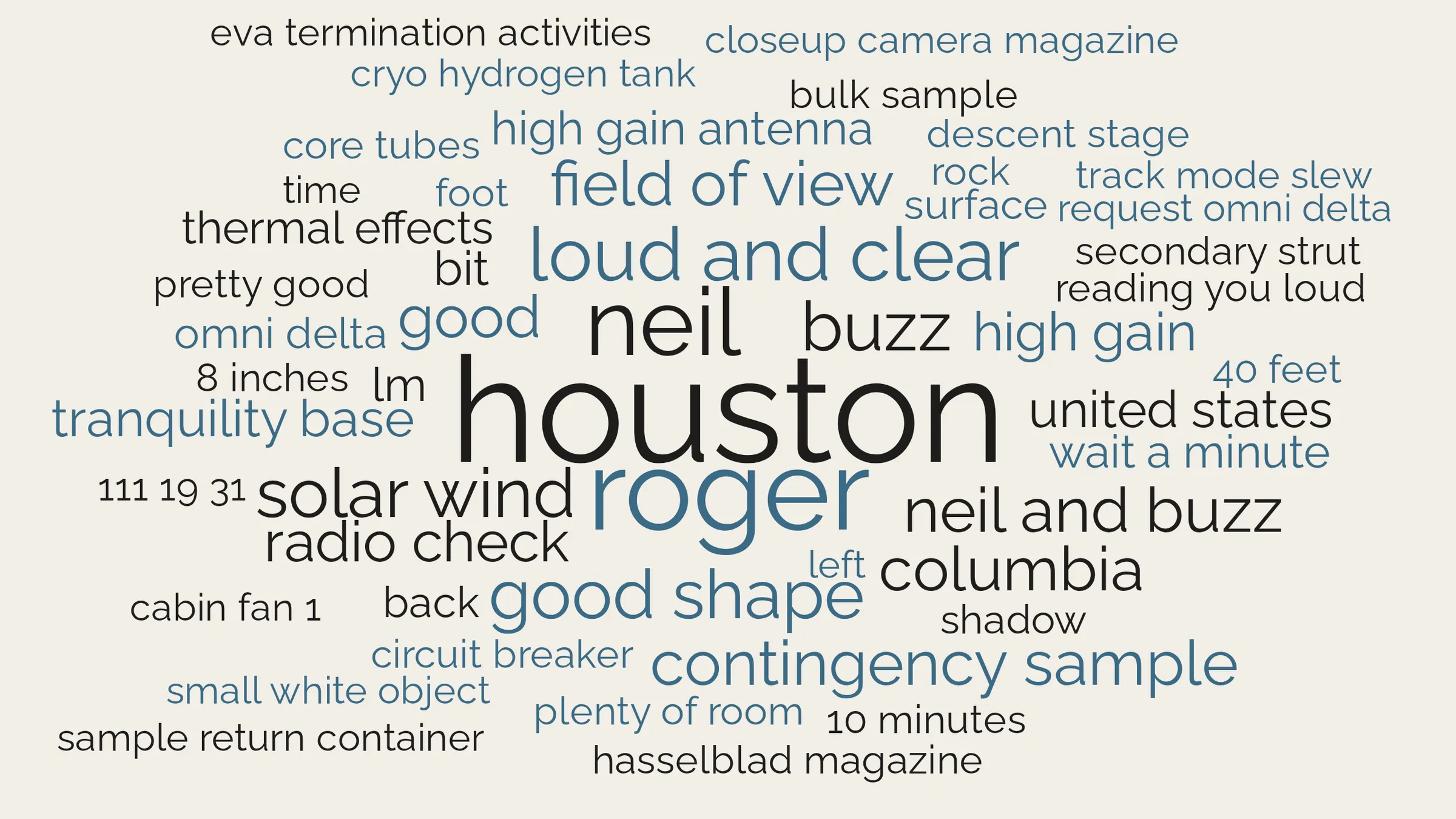
The second cloud is three hours of the moonwalk itself — 641 transmissions, 8,038 words, 1,802 unique. The vocabulary changes completely.
Houston is now the largest word (108) and roger has slipped to second (79). More telling than the order is the density: on the way down, one word in thirty-three was “roger”; on the surface it is one in a hundred and two. Procedure thins out and objects arrive. Contingency sample (7). Bulk sample. Core tubes. Solar wind. Hasselblad magazine. Closeup camera magazine. Sample return container. Small white object.
And names. Neil 69 times, Buzz 47. On the way down the two men were call signs — Eagle, Columbia, Tranquility Base. On the surface they are two people with a camera and a bag, being told where to stand.
The quiet star of the second cloud is shadow, which comes up sixteen times. Shadows on the Moon are absolute, with no atmosphere to soften them, and a great deal of the conversation is two men working out what they are actually looking at.
What the cloud cannot see
Now the honest part. A word cloud measures how often something was said. It has nothing whatsoever to say about whether it mattered.
Every important sentence in this corpus is a singleton. “The Eagle has landed” — once. “That’s one small step for (a) man, one giant leap for mankind” — once. “Magnificent desolation” — once. Armstrong’s flat, extraordinary “I’m going to step off the LM now,” logged at 109:23:43 — once. Statistically, each is indistinguishable from somebody saying “aft omni.” This is a general property of language rather than a quirk of Apollo: the best line in any body of text is almost always said exactly once, which is a good part of why it is the best line.
So what is a frequency cloud for? Texture. It shows you what a body of speech is made of during the long stretches when nobody is being quotable — which, in the case of the first landing on the Moon, is radio checks, circuit breakers, sample bags and an enormous quantity of “roger.” Six hundred million people were listening for a sentence. The two men on the surface were, for the most part, discussing the antenna.
Method
Source: NASA, Apollo 11 Technical Air-to-Ground Voice Transcription (GOSS NET 1), published via the NASA History Division’s Apollo Lunar Surface Journal. As a work of the United States Government it is in the public domain.
Two slices were taken by ground elapsed time: 101:00:00–103:30:00 (descent and landing) and 109:00:00–112:00:00 (the first EVA). Speaker labels, channel markers, page headers and the transcript’s own editorial notes were stripped; only spoken words were kept. Whole-mission totals (123,000 words, 8,433 transmissions) are our own count over the same cleaned text.
Both clouds were built in WordCloud+ on default settings: 50 terms displayed, multi-word phrases extracted automatically, and the built-in 573-word stop list left exactly as it comes. Nothing was added to it and nothing was removed. The only thing we changed was the palette. All quoted frequencies are WordCloud+ occurrence counts, read off the Summary tab.
This series is produced automatically: an AI picks the corpus, builds the cloud and writes the piece, and a human keeps an eye on it. The numbers are checked against the source; the jokes are nobody’s fault but the machine’s.
Keep reading
We counted every word of the new Prime Minister’s first PMQs
Parliament came back, Andy Burnham took his first PMQs, and 6,558 words went into WordCloud+. The first cloud was useless — which turned out to be the interesting part.
World Menopause Day: A word cloud to uncover menopause experiences and stories
Discover the fourth secret 'P' in women's health: perimenopause. Learn why it's crucial for education and awareness, featuring insights from the Not Sorry Club and UCL research.
What did people think about the new Barbie film?
Explore the new Barbie movie through 225 Google reviews. Discover key insights on Margot Robbie's performance, Greta Gerwig's direction, and the film's stance on the patriarchy using a detailed word cloud analysis.
Try it on your own text
Paste text, rank the phrases that matter, export the cloud.